India (Boxen)
Surprised by JoyIndia (Boxen) is the fictional country created by C. S. Lewis’s brother and made part of the shared imaginative world the brothers built in childhood. Initially his brother’s own domain, it became one of the two constituent countries of Boxen, linked to Animal-Land by geography, steamship routes, and a common political assembly while retaining its separate king.
Origins and Shared Invention
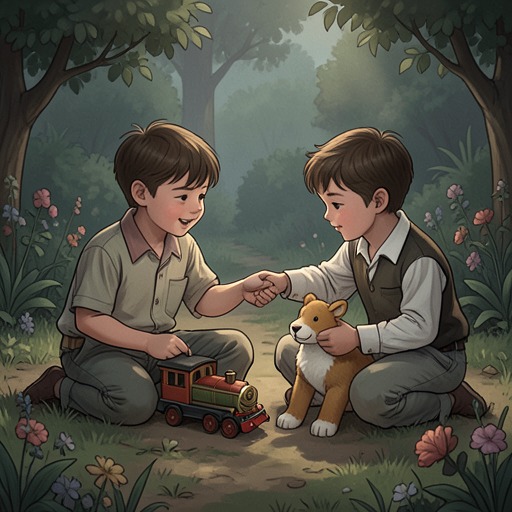
The brothers’ earliest drawings show their different imaginative interests: his brother drew ships, trains, and battles, while C. S. Lewis drew anthropomorphic animals. His brother’s first story, The Young Rajah, had already made India “his country”; Animal-Land was C. S. Lewis’s. Their domains began as distinct territories shaped by the interests each brought to their play.
The separation did not prevent collaboration. When the brothers’ holiday games brought modern Animal-Land into action, it needed trains and steamships to become a country they could share. C. S. Lewis then connected his medieval animal stories to that modern setting by treating them as an earlier period in the same country. From there, the invented histories and maps expanded beyond either brother’s original territory.
Geography and Connection to Animal-Land
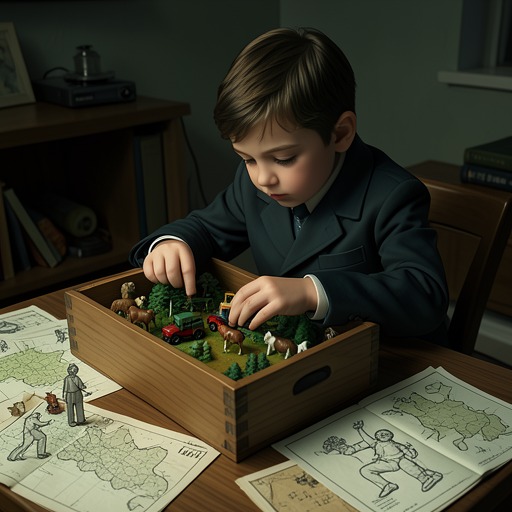
The brothers placed India as an island, with its north coast running along the back of the Himalayas. Between it and Animal-Land, C. S. Lewis’s brother rapidly invented the principal steamship routes. The relationship thus became both geographic and practical: the countries were distinct, but travel between them helped make them parts of one imagined world.
That world acquired a map using every color in C. S. Lewis’s paintbox. The places the brothers regarded as their own—Animal-Land and India—were increasingly populated with consistent characters. India’s place in the design was therefore not just a name on a map; it was one half of a paired imaginative territory whose people and connections could be developed across stories and play.
From India to Boxen
In a later elaboration of the fictional history, Animal-Land and India were united into the single state of Boxen, at some point in their imagined late eighteenth century. They retained separate kings, but shared a legislative assembly called the Damerfesk. India consequently remained distinguishable within the union even as the brothers’ world gave it a place in a wider political structure.
Boxen’s arrangement extended the children’s world-building beyond maps and travel. Its assembly could be summoned to different locations, and its effective power could rest with a Littlemaster rather than with the kings. India’s later place in this system illustrates how the brothers developed their childhood countries into a history and polity, with connected institutions as well as separate national identities.
Narrative Significance
India (Boxen) records the collaborative character of the brothers’ imaginative life: one brother supplied the country, while their shared games and C. S. Lewis’s historical and geographical elaborations connected it to Animal-Land. The country also shows how play could become systematic construction. A childhood territory acquired routes, maps, a past, and eventually a role in Boxen’s common government.
The adult account preserves India as part of the brothers’ outer imaginative life, distinct from the private imaginative experiences C. S. Lewis elsewhere associates with Joy. Its significance lies in that concrete childhood collaboration: India gave his brother’s invented world a home, then became one of the foundations of the larger shared world they made together.